The Ceiling of On-Demand: Why This Broadcaster Hit a Wall
We’ve all been there. You start a podcast with a vision to change the world, one episode at a time. You spend hours researching, recording, and then—the real grind—editing. You scrub through audio files, removing every “um” and “ah,” trying to craft the perfect narrative. But after a year of consistent uploads, many creators realize they’ve hit an invisible ceiling.
The problem isn’t the content; it’s the delivery method. The “record-edit-upload” cycle creates a massive time lag between your thought and your listener’s ear. By the time an episode drops, the conversation has often moved on. You’re speaking into a void, hoping that someone, somewhere, is downloading the file and listening to it in their car three days later.
This creates a gap between passive listeners and an active community. A podcast listener is often a consumer—they take the information, enjoy the show, and move on. But a radio listener is a participant. There is a psychological difference between saying “I listened to that episode” and “I was there when that happened.”
For the broadcaster in our case study, the breaking point came when they realized their growth had plateaued. They had a loyal following, but the connection felt clinical. They wanted the energy of a live room, the thrill of an unexpected guest, and the ability to pivot the conversation based on real-time feedback. They realized that true radio station success isn’t just about the number of downloads; it’s about the strength of the live connection.
The pivot point was clear: to scale engagement, they needed to stop being a content producer and start being a broadcaster. They needed a way to bridge the gap between their archived knowledge and a live, breathing audience.
The Migration: Moving the Community to a LoovaCast Station
Moving from a podcast to a live station can feel like a daunting leap, but it doesn’t have to be a total restart. The secret is integration. Our case study broadcaster didn’t throw away their old episodes; instead, they used them as the foundation for their new 24/7 presence on LoovaCast.
The first step was integrating the existing podcast feed into a live stream. By scheduling their best-performing archived episodes to play during “off-peak” hours, they ensured the station never went silent. This transformed their podcast from a series of files into a curated radio experience. The LoovaCast dashboard allowed them to balance these automated “best-of” sets with live talk blocks where they could engage directly with the community.
This created a psychological shift for the audience. Listeners stopped thinking, “I’ll get to that episode eventually,” and started thinking, “I need to tune in at 7 PM to hear the live discussion.” This is the essence of “appointment listening.” When you provide a specific time and place for a community to gather, you create a sense of urgency and exclusivity that on-demand content simply cannot replicate.
We saw the broadcaster move from a sporadic upload schedule to a structured radio clock. They dedicated mornings to music and curated clips, afternoons to industry news, and evenings to high-energy live interaction. This structure gave the audience a roadmap of what to expect, turning a casual hobby into a professional-grade broadcast operation.
- ☑ Audit your top 5 podcast episodes for live repurposing.
- ☐ Set up your LoovaCast station branding (Logo, Bio, Social links).
- ☐ Create a ‘Live Schedule’ graphic for social media to announce your hours.
- ☐ Test your stream latency on multiple devices to ensure a smooth transition.

Breaking the Fourth Wall: Real-Time Engagement Strategies
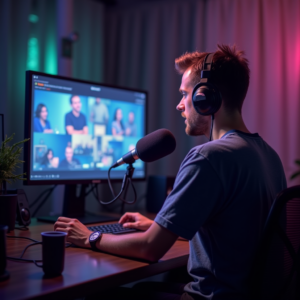
Once the infrastructure was in place, it was time to break the “fourth wall.” In podcasting, the wall is the editing software. In live radio, that wall is demolished. The broadcaster began using live call-ins and instant requests, transforming the listener from a spectator into a co-creator of the show.
Imagine the difference: in a podcast, a listener sends an email, and the host answers it two weeks later. In a LoovaCast station, a listener sends a request or a shout-out, and the host acknowledges it within seconds. This instant gratification creates an emotional bond that is incredibly powerful. It makes the listener feel seen and heard, which is the fastest way to build brand loyalty.
The broadcaster also implemented the “Live Event” strategy. Instead of just “talking,” they hosted themed takeovers. For example, they would invite a guest for a “Live Q&A Hour” where the guest didn’t just answer pre-recorded questions but responded to the live chat in real-time. These events became magnets for new listeners, as the “Live” tag on the station acted as a beacon for curiosity.
When comparing metrics, the difference was staggering. While the podcast had higher “total plays” over time, the live broadcasts had significantly higher “session duration.” People weren’t just clicking play and leaving; they were staying tuned in for hours. The unpredictability of live radio—the laughter, the slight mistakes, the spontaneous tangents—made the experience feel human and authentic.

Scaling the Sound: From Local Hobby to Global Reach
As the station grew, the broadcaster faced a new challenge: scaling. When a live event goes viral or a guest with a large following joins the stream, you can see a sudden spike in traffic. This is where the infrastructure of LoovaCast becomes a critical component of radio station success.
Unlike a self-hosted server that might crash under the weight of a thousand simultaneous listeners, LoovaCast is built to handle the surge. The broadcaster was able to scale from a few dozen “regulars” to thousands of global listeners without a single stutter in the audio. This reliability allowed them to focus on the content rather than the technical anxiety of server loads.
They also mastered the art of cross-promotion. They didn’t just tell people to “tune in”; they used “live snippets.” They would take a 60-second highlight from a live broadcast—a funny moment or a shocking revelation—and post it as a Reel or TikTok with a call to action: “Hear the full conversation LIVE tonight at 8 PM.” This created a funnel that moved social media scrollers into active radio listeners.
Consistency became their superpower. By sticking to a rigorous broadcast schedule, they built a habit in their audience. Listeners began to integrate the station into their daily routines—tuning in during their morning commute or while winding down for the evening. This “appointment listening” is the holy grail of broadcasting because it makes your audience predictable and your growth sustainable.
- A) Technical setup fear
- B) Finding the right content
- C) Fear of dead air
- D) Promoting the station
Share your answer in the comments!
Measuring the Win: The Data Behind the Success
To truly understand the impact of this transition, we have to look at the numbers. The broadcaster didn’t just “feel” like the station was doing better; the data proved it. The most telling metric was the listener retention rate. In the podcast format, there was a significant drop-off after the first ten minutes of an episode. In the live LoovaCast format, listeners stayed tuned in for an average of 45 minutes per session.
The “Live” status also acted as a powerful organic growth engine. New listeners are more likely to click on a station that is currently “On Air” than they are to browse a library of 100 archived podcast episodes. It lowers the barrier to entry. A new user can jump in mid-conversation and immediately feel the energy of the community, which leads to a much higher conversion rate from “visitor” to “follower.”
In the final analysis of this case study, the broadcaster saw a 300% increase in community interaction. This wasn’t just measured in likes, but in active participation: call-ins, chat messages, and requests. The transition from a one-way communication channel (podcast) to a two-way conversation (radio) completely changed the trajectory of their brand.
By leveraging the analytics provided by LoovaCast, they could see exactly which time slots were most popular and which topics kept the needle in the red. This allowed them to refine their programming in real-time, doubling down on what worked and pivoting away from what didn’t. This data-driven approach is what separates a hobbyist from a professional achieving long-term radio station success.
Your Turn: Mapping Your Path to Radio Station Success
You don’t need a massive studio or a degree in broadcasting to make this leap. The first step is identifying your unique “Live” value proposition. Ask yourself: What can I provide in real-time that a recording cannot? Is it instant expertise? A curated mood? A space for your community to vent and laugh together? Once you find that “Live” spark, you have a foundation to build on.
We recommend starting small. You don’t have to commit to a 24/7 live presence on day one. Start with “Live Hours”—perhaps two hours every Tuesday and Thursday. Use the rest of your time to run automated playlists or your best podcast archives. This prevents burnout and gives you time to find your voice and rhythm without the pressure of filling 168 hours of airtime every week.
Experiment with the LoovaCast toolkit. Play with the scheduling, test out different music rotations, and most importantly, talk to your listeners. The beauty of online radio is that it’s a living, breathing entity. It evolves as your community evolves. Your voice is your greatest asset; don’t be afraid to let it be imperfect, raw, and real.
Whether you are a seasoned podcaster looking to scale or a complete newcomer with a passion for music and talk, the path to radio station success is open. The technology is here, the audience is waiting, and the only thing missing is your signal.
Ready to launch your station? Get started with LoovaCast — your radio, your way.